

Intel’s ‘Ice Lake’ 10th-gen Core CPUs boost graphics and Wi-Fi, tap AI to offset slower turbo speeds - jonesdond1985

Intel
Intel's forthcoming 10nm "Ice Lake" central processor won't return any more cores and duds than its current 8th-gen parts, and at slower turbo clock speeds. But what Intel is calling its 10th-gen Core chip here at Computex offers numerous improvements crossways the board: performance boosts across Processor, graphics, and AI tasks, plus platform-level enhancements like "Wi-Fi 6 Gig+" that offers to a greater extent bandwidth than your wired router.
The Glass Lake-settled 10th-gen processors will be Intel's first widely ready 10nm Core group chipsand the company's outset major come off redesign since 2015's Skylake architecture. They're now shipping, Intel's Gregory Bryant, older vice President and systemic manager of the Client Computing Aggroup, is expected to order in his Computex address.
Since January, Intel has aforesaid that the starting time Ice Lake chips would send to customers this canton, specifically in June, as part of an initial crop of 30 notebooks which testament appear along store shelves by this holiday flavour. Ice Lake will substitute the on-going "Whiskey Lake" U-series and "Amber Lake" Y-series Core chips with 9W, 15W, and even some 28W versions.
Patc Intel's holding noncurrent specifics on individual chips, we all the same now know rather a piece about the Ice Lake family As a whole: CORE i3, i5, and i7 chips volition constitute offered, with adequate to 4 cores and 8 threads—the same as Whiskey Lake. Ice Lake's turbo boost speed of upbound to 4.1GHz is far less than the Whiskey Lake-based Core i7-8565U's 4.6 Gigacycle boost, but a new, improved method of turbo management may mitigate that. Finally, the return of (now Gen11) Iris Plus integrated GPUs could be a big deal that widens the options available for notebook computer gaming.
A Dingle referee's guide provided to PCWorld as wel added several additional branding detail that Intel didn't provide: Ice Lake appears to use a "10xx" designation, with a graphics suffix. For example, the reviewer's guide revealed the existence of the 10th-gen Core i3-1005 G1 (upwardly to 3.4GHz); the 10th-gen Core i5-1035 G1 (skyward to 3.7GHz); and the 10th Gen Core i7-1065 G7 (capable 3.9GHz). (The "G" suffix likely refers to what graphics level is available—integrated or the Iris Plus.) In total, in that location will equal 11 new versions of Methedrine Lake, Intel executives said.
Performance Book of Numbers, though, are still vague. The most concrete estimate of Ice Lake's performance soundless comes from Intel's investor meeting: twofold the encode and graphics performance of Whisky Lake. But on that point's a wild card. Remember how Intel's 7th-gen "Kaby Lake" processor was optimized for video playback, because of the rise of YouTube and Netflix? Methedrine Lake makes similar strides in AI. You'll also visualise close to unexpected perks in how Intel implements an enhanced Wi-Fi 6 Lanc+ receiving set technology and Thunderbolt 3, too.
 Gordon Mah Ung / IDG
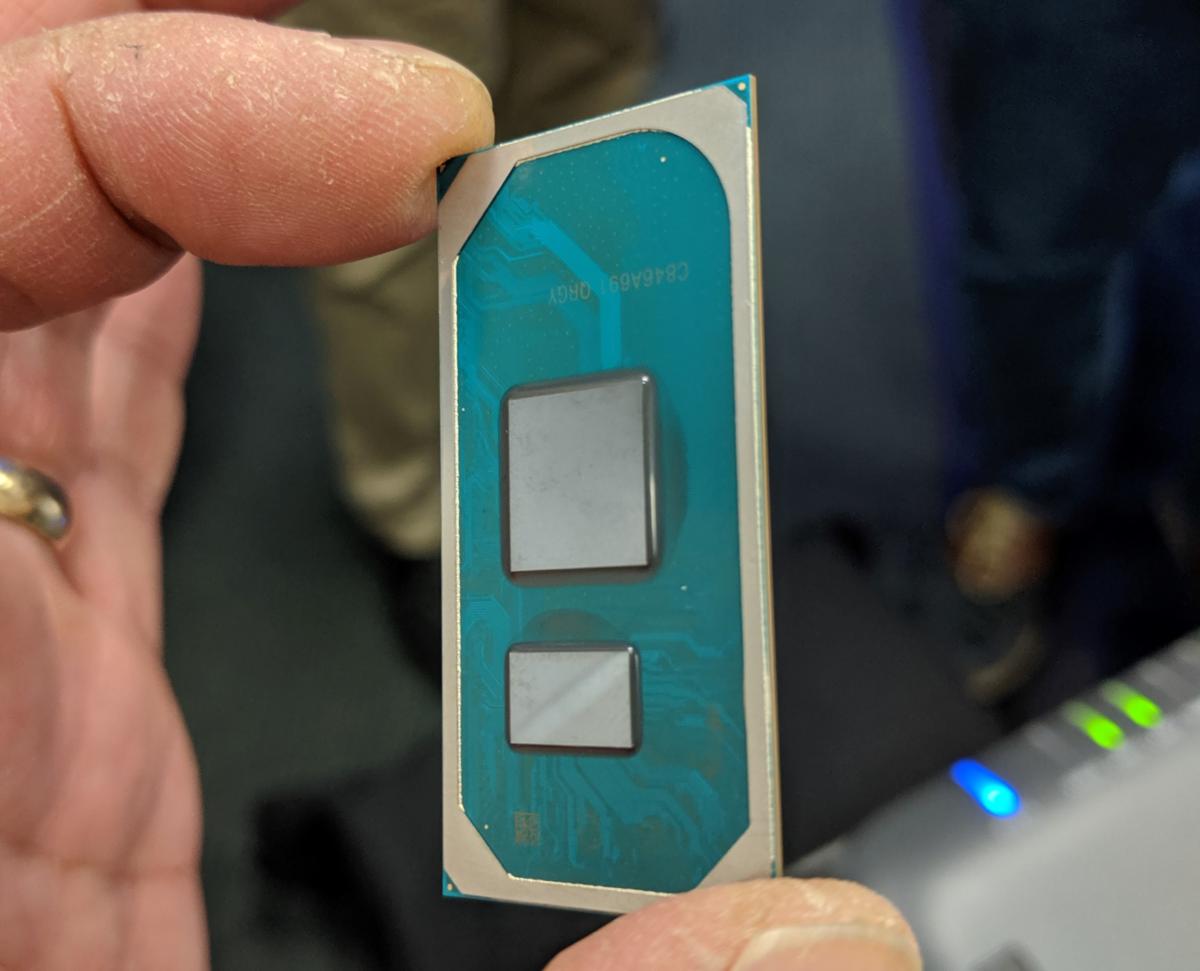
 Intel's higher-power U-serial Chicken feed Lake chip demands a larger package than the Y-series, the smaller chip shown in the illustration at the top of this floor.
In his Computex keynote, Bryant also announced 9th-gen vPro chips, with up to 8 cores and 16 togs reaching up to 5GHz on desktop and up to 4.8GHz along mobile—even a Core i9. Intel also launched 14 new Intel Xeon E processors for Mobile and desktop workstations. Bryant also discovered that a new series of "X-series" Ice Lake chips wish debut this dusk, aboard increased memory accelerate and an updated Intel Turbo Cost increase Max Technology 3.0. Bryant also showed soured the hot Intel Performance Maximizer, an automatic overclocking tool.
How latched is Ice Lake? Here's what we know
Much of Ice Lake's design was informed by Protrude Athena, Intel's redesign of the ultrabook. Chris Walker, frailty chair and general manager of the Client Computing Group at Intel, aforesaid that the modern workforce has to be wont to switching back down and away between a exponent plug away and a stamp battery, between go and living. Consumers rate connectivity and long battery life, Intel says, only they turn to the Personal computer to concentrate on a task, wherever they may be.
"It's non a separate work PC and a class home PC, information technology's one—and we'll start to see that coming into our partners' plan speech," Walker same.
In some sense, that lessens the impact of Ice Lake Eastern Samoa a CPU, and emphasizes the broader appeal of Shabu Lake as a platform. The fact remains, however, that so much of the PC silent revolves around the processor, and about Intel's struggles to move beyond 14nm.
 Intel
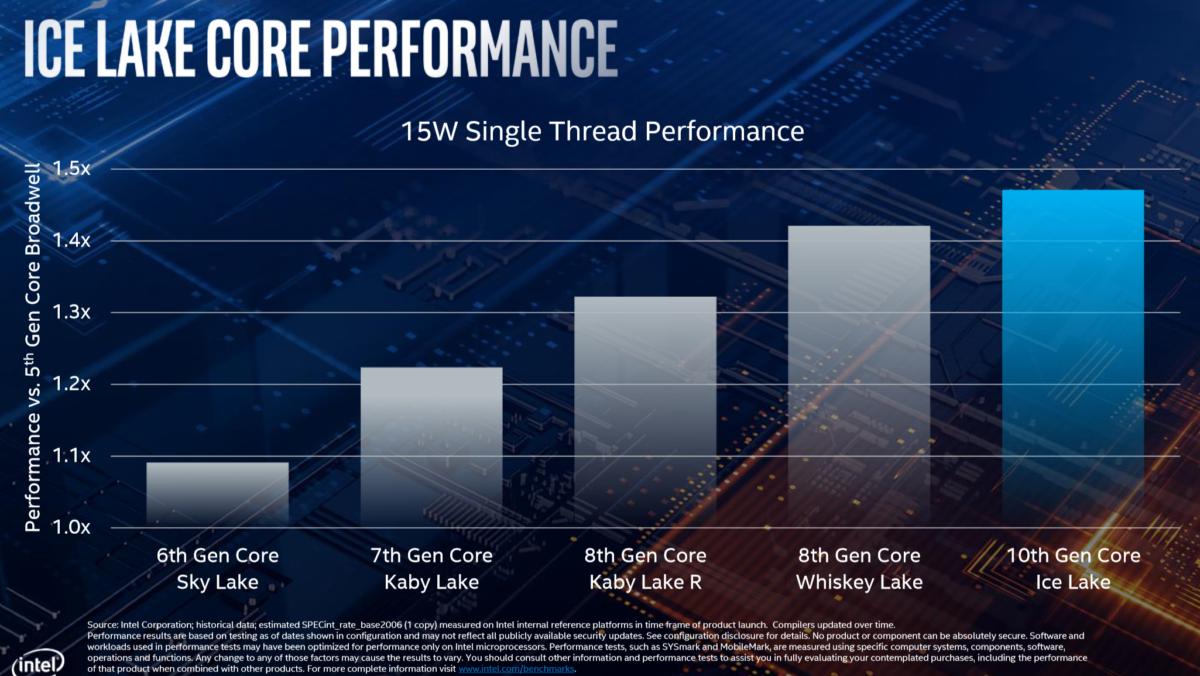
Intel Intel's one-man-rib performance improvements assume't look especially material, somewhere on the order of nigh 3 percent if you kickoff parsing the numbers.
At that place's an old adage in the chip industry: ne'er launch a new processor design on a newly manufacturing process, because of the increased risk of dear manufacturing errors. Intel seems to believe IT's dodged that peril, as last year IT launched the untested 10nm process via Cannon Lake, a relatively unknown Core i3 chip that Intel shipped to Asia finale year as office of a Lenovo notebook computer. Becky Grummet, an Intel fellow and the Chief Client Architect, aforementioned that every while of IP on Ice Lake was "touched" and optimized for 10nm.
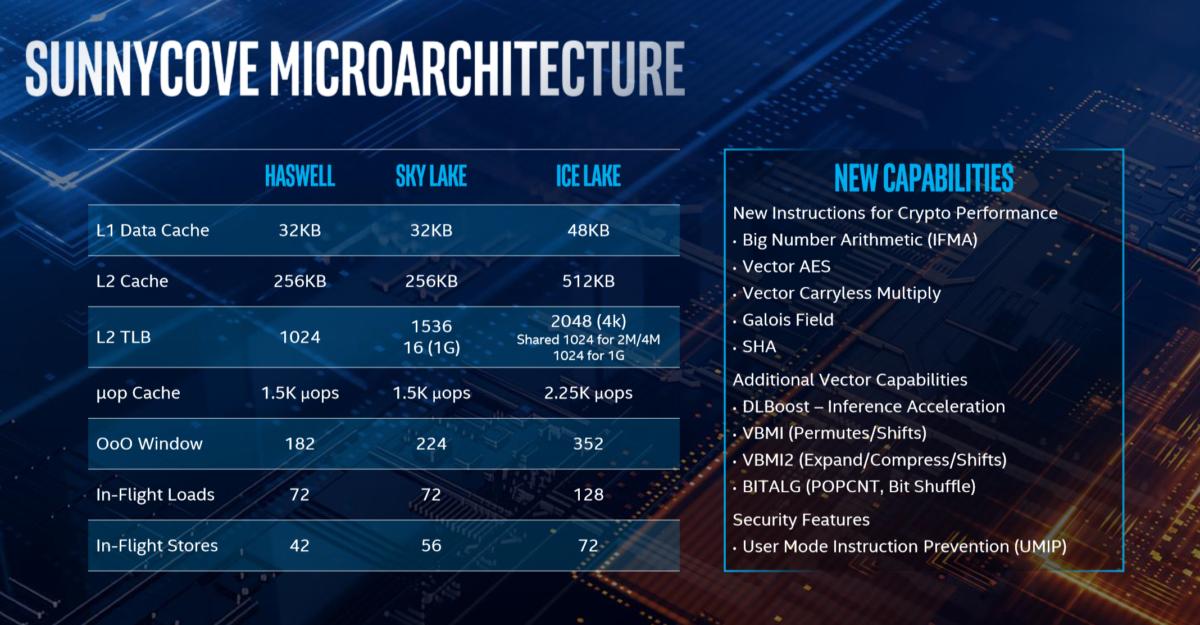
Ice Lake, however, is built upon the new "Sunny Cove" (now apparently spelled Sunnycove) core design that Intel disclosed late terminal year. Sunnycove was designed to be deeper, wider, and smarter, in the words of one executive. In reality, that agency that Sunnycove chips ilk Shabu Lake can perform more operations in symmetrical (5, versus 4 in Skylake) and with an increase of 8 to 10 execution ports. Sunnycove's level 1 data cache has increased from 32KB to 48KB, and the level 2 cache from 256KB to 512KB. Caches are used to store oftentimes used instructions, versus having to William Holman Hunt them down from system memory. Think about them in the same right smart that heavy, mystifying pockets are effective places to store things you frequently need.
 Intel
Intel The detailed specs associated with the Bright Cove (or "Sunnycove") processor computer architecture.
In general, Intel's claiming that the Sunny Cove-based chips leave perform, on average, 18 percent more instructions per clock cycle than the Skylake architecture crosswise a variety of benchmarks. Intel's besides added book of instructions for particularised tasks, such equally crypto performance, transmitter AES, and security enhancements such as Substance abuser Mode Instruction Prevention.
Fulfill Ice Lake's Gaussian Neural Gas
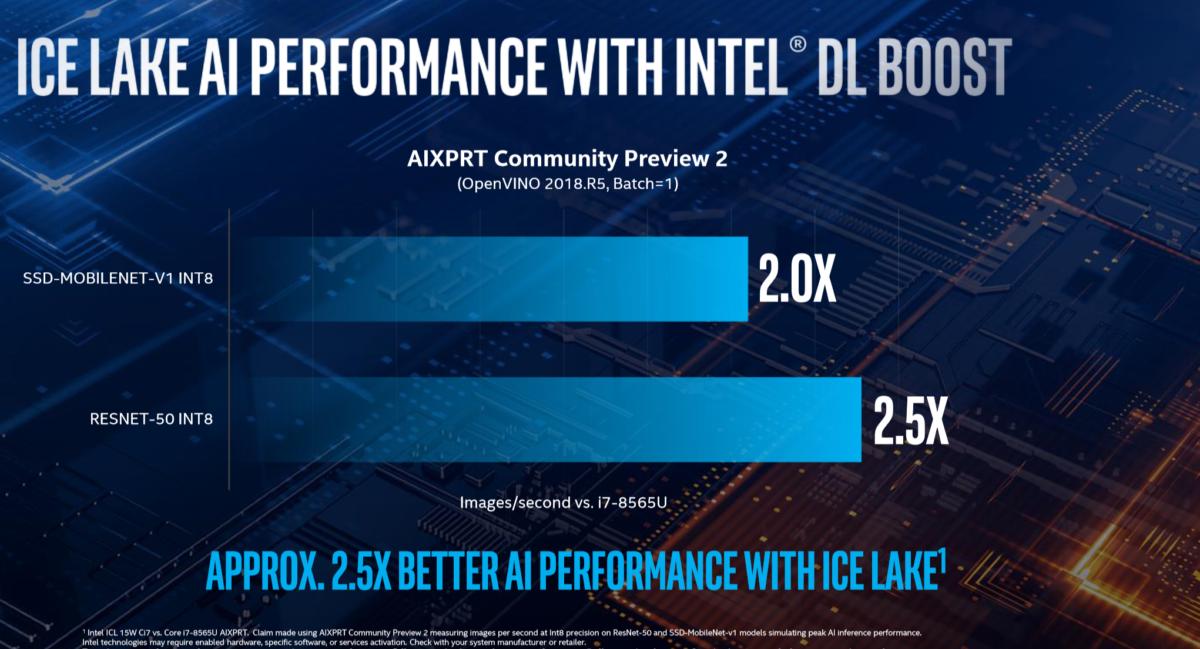
Intel, though, successful at least two specific improvements for AI: adding DL Boost (Deep Scholarship Boost) instructions and a Gaussian System Atom smasher, a dedicated system of logic core designed to hotfoot up AI functions. Don't think up AI in terms of extremity assistants care Cortana or Alexa. Instead, both of Ice Lake's new technologies are designed to cannonball along up tasks such as background blurring in Microsoft Teams, semantic research in Microsoft Photos, OR recognition and recording of a patronage get together.
 Cross out Hachman / IDG
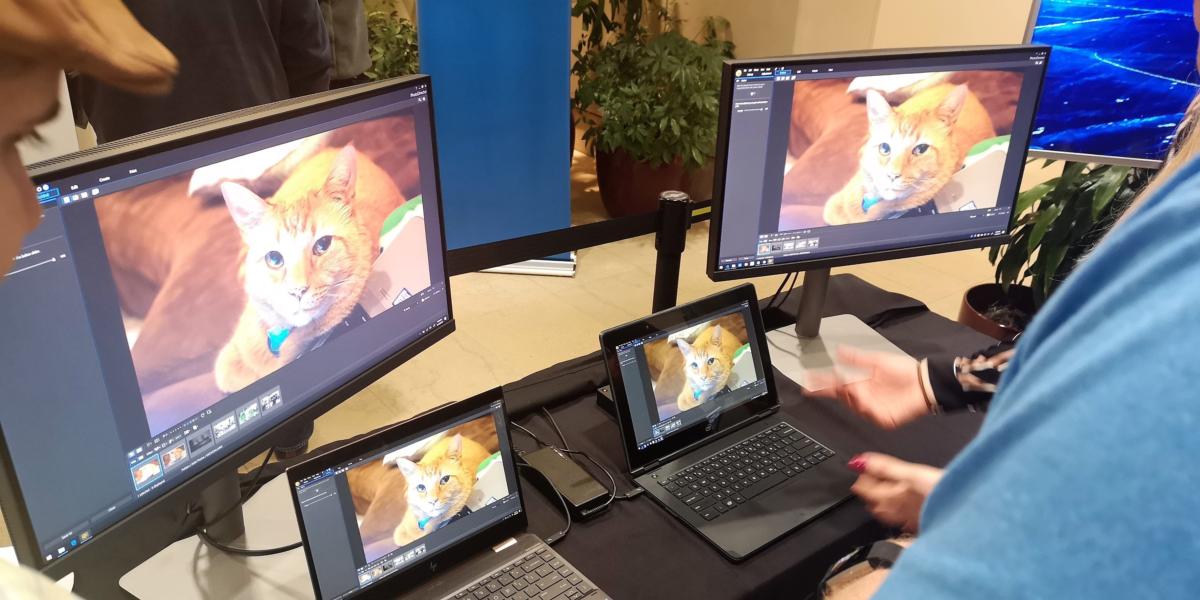
 IT's fractious to see therein photo, but Intel's AI capabilities were existence shown dispatch in these cat photos, which were being Diamond State-muzzy (made less blurry) using AI.
It's the latter task that Ronak Singhal, an Intel fellow and music director of the CPU Computing Architecture, called come out the Gaussian Neural Particle accelerator for. It runs perpetually in the background, but at very low-set power, acting a computationally modifier task without blazing through your battery. Bright Cove, Intel claimed, offers between 2 to 2.5 multiplication more public presentation in Artificial insemination compared to the "Whiskey Lake" Core i7-8565U.
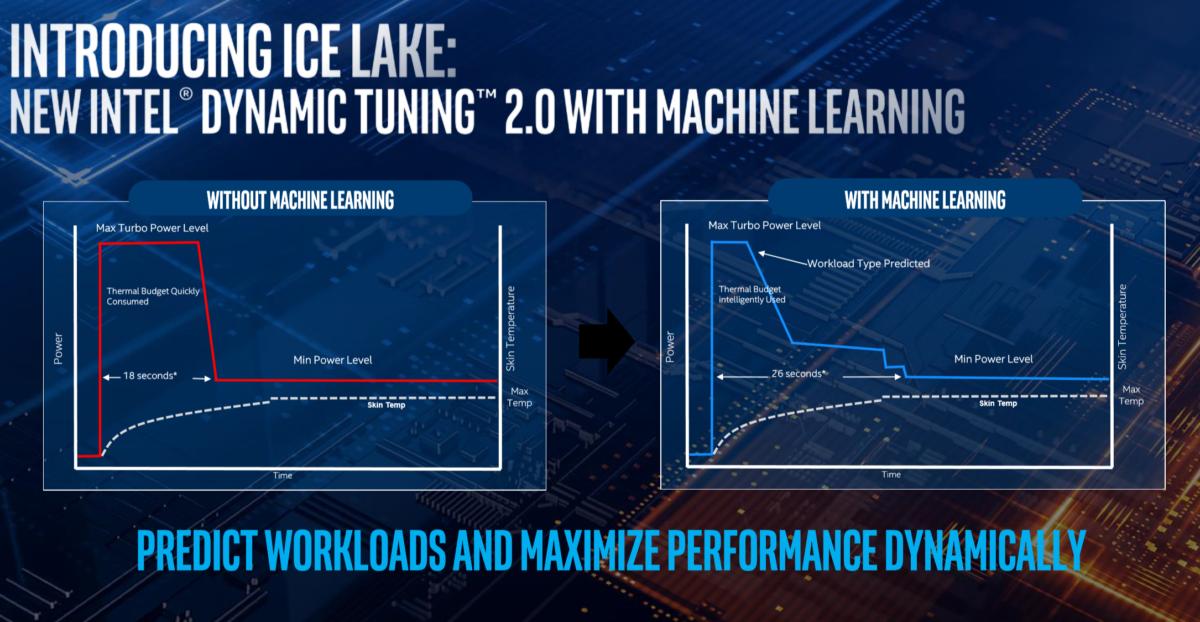
Executives also said that Glass Lake uses AI to manage boost performance, what it calls Intel High-octane Tuning 2.0 with Motorcar Learning. Unlike elderly generations, which used more of an "all or nothing" approach to utilise the overclocking capability in a buffalo chip's Turbo Boost, Intel's Dynamic Tuning feathers the accelerator a bit, boosting aggressively, past voluntarily backing remove, while trying to determine the "just enough" level of overclocking performance and prolong that as long every bit it can. Intel hopes that this fresh performance management will overcome the lower turbo boost threshold, though it corpse to be seen if that's true.
 Intel
Intel Ice Lake's ability to dynamically manage and tune turbo advance performance could represent one of the ways in which IT will outperform its predecessors. We'll have to wait for real-world testing to confirm this, however.
Unfortunately, Intel said very little about Ice Lake's factual power consumption, though the head-shrinker to a finer 10nm process should theoretically lower IT, extending a notebook PC's battery life. Ice Lake as wel includes fully desegrated voltage regulators, Loop said.
 Intel
Intel Intel's Gaussian system accelerator seems to be optimized sure enough AI-specific instructions that prat power a form of tasks.
Next page: Graphics and Wi-Fi improvements, Water ice Lake vs. Ryzen 3000
How Ice Lake's Gen11 graphics volition boost PCs
While Intel works to bring its Atomic number 54 GPU architecture to commercialise, the Gen11 graphics at the center of Ice Lake represent a "John Roy Major jump off forward in the journey to a untouched-scale built-out architecture," according to Lisa Pearce, frailty president of Intel Architecture, Graphics and Software. The overall intention end, Pearce said, was baron efficiency.
The most identifiable features of the Gen11 graphics architecture are the accumulated number of execution units, summation Intel's new support for adaptive synchronise displays. (EUs are Intel's programmable shader units, with 3D rendering, cipher, programmable and flat-function media capabilities.) Notebook vendors (and you) will also constitute healthy to choose from either UHD or Iris diaphragm Summation graphics options. That's a change, as the prior Gen9.5 GPU generation pledged to Intel's 8th-gen Core chips skipped the Iris Plus designation altogether.
(Intel's branding can embody disorienting. Intel's Gen9 artwork debuted with Skylake; Gen9.5 was start of the Kaby Lake and Umber Lake chips. Intel designed Gen10 artwork with Cannon Lake in mind, but since the only 10nm Cannon Lake chip that shipped was a Core i3, there was no need for high-end graphics.)
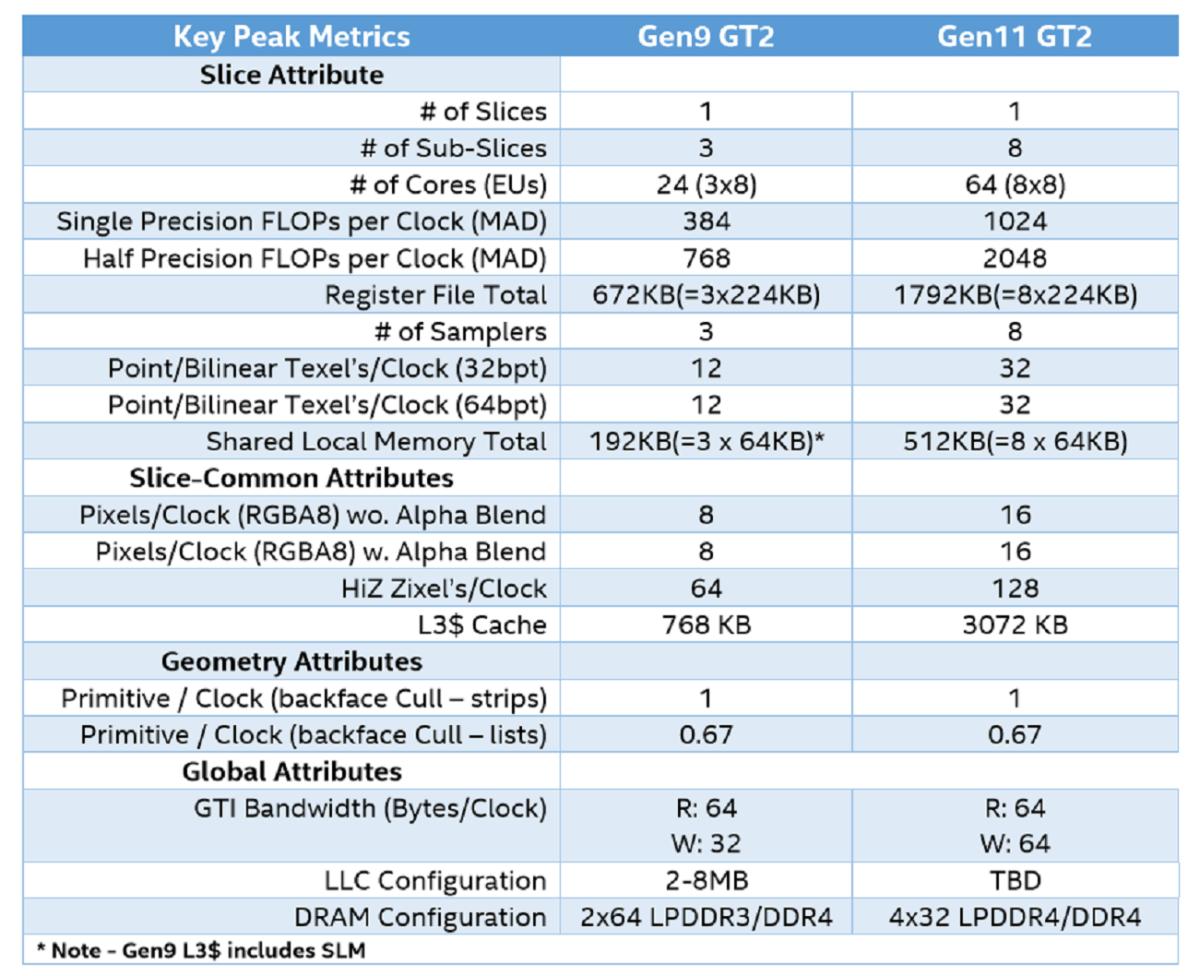
Intel's Gen9.5 art used anywhere from 12 to 48 murder units, with the nigh EUs rarified for the Iris Positive Artwork. Ice Lake's Gen11 graphics, along the other hand, nowadays let in up to 64 EUs running at up to 1.1 GHz, Pearce said, for a total of 1.12 teraflops of 32-snatch compute performance. From a expose standpoint, Gen11 graphics get the power to support triad simultaneous 4K displays at 120Hz, a pair of 5K displays at 60Hz, or a single 8K30 expose. The graphics engine includes three presentation pipes that support DisplayPort 1.4 HBR3 and HDMI 2.08, advantageous HDR10 and Dolby Imaginativeness. On that point's also a pair of fixed-subroutine HEVC/VP9 video encoders.
 Intel
Intel Abyssal inside the speeds and feeds of Intel's Gen11 graphics, for those who want it. A to a greater extent generalised comparability of play performance lies below.
While the integrated GPU will include a 3MB L3 cache, Intel's next-gen graphics will over again share local memory with the CPU (specifically 0.5MB). Sharing the memory allowed for more operation efficiency, Pearce said. The Gen11 GPU also boasts an enhanced rasterizer with 16 pixels per clock, and 32 bilinear filtered texels per clock, versus 12 in the prior contemporaries.
Tras Lake also marks the first time Intel has verified the VESA-standard Adaptive Synchronise implementation that AMD's FreeSync technology is based upon and Nvidia recently embraced, kind of. Adaptive Sync technology synchronizes the refresh rate of harmonious monitors and compatible graphics chips, providing a far smoother gameplay undergo. Pearce also said that applying Adaptative Synchronise would give in 1.8 times faster frame rates than without it.
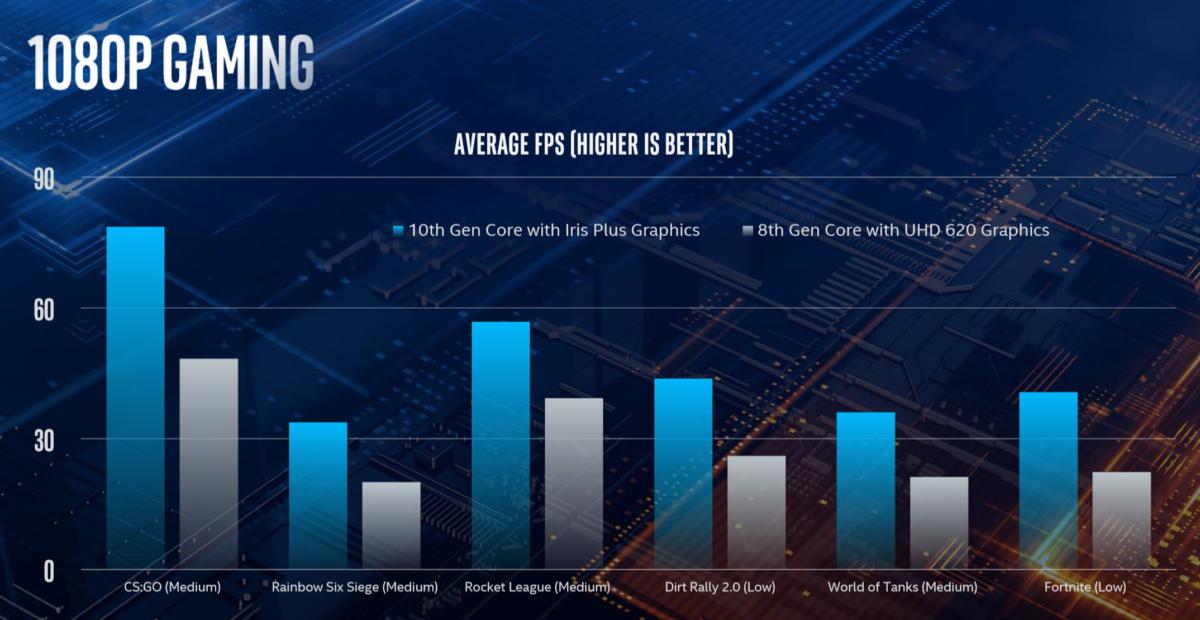
So how will this totally play unstylish in the real world? Intel published an early attend at the compose rates you can expect from its new Flag Plus graphics GPUs, seen below. Intel's Command Focus on software program now performs one-click optimizations for 44 games. Otherwise, you can travel to gameplay.intel.com and Intel's cloud service wish car-detect your hardware and advocate playable settings for over 400 games. Intel's new Gen11 graphics will be fully supported in Linux by the third fourth part, too.
 Intel
Intel Intel claims that its Gen11 graphics will turn in substantially much gaming performance than its predecessor, the UHD 620 GPU recovered alongside Intel's 8th-gen Core chips.
WI-Fi 6 Gig+, integrated Thunderbolt 3
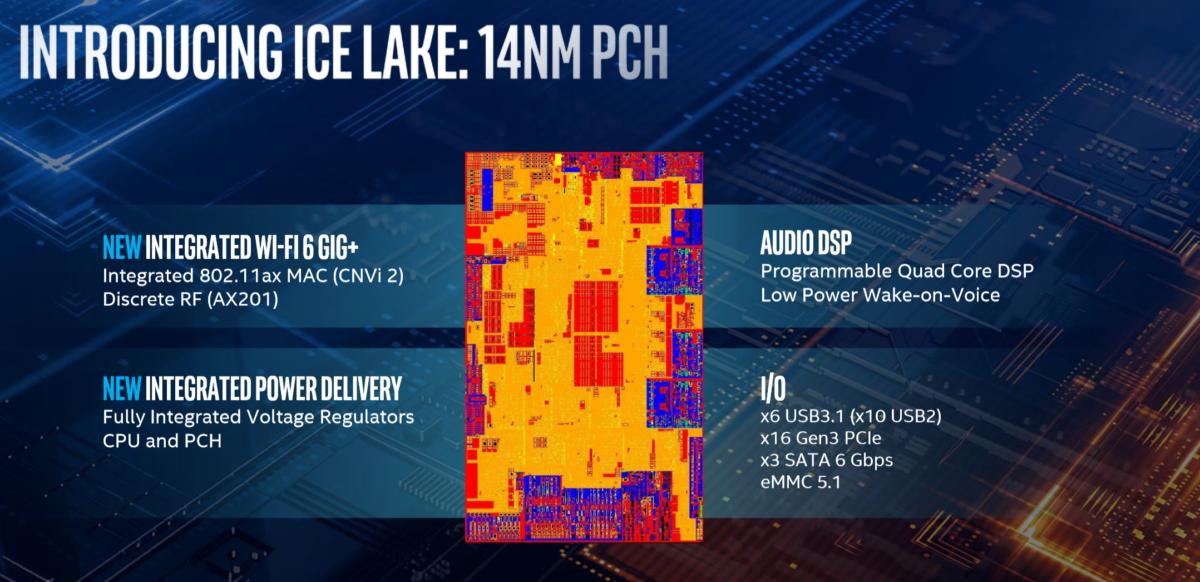
Like other Intel processors, at that place's more than just the CPU inside Shabu Lake. Though the Sunny Cove C.P.U. burden is fabricated on a 10nm bundle, what's called the Platform Controller Hub (PCH) is fancied from an older 14nm sue, and sits within Ice Lake's multi-chip software packag. It's Hera, on the PCH, that you'll find Icing Lake's mightiness and connectivity features: the new structured Wi-Fi 6 Gig+, I/O, and the revolutionary integrated power delivery system.
 Intel
Intel Ice Lake will support LPDDR4-3733 memory options up to 32GB, operating theatre DDR4-3200 up to 64GB. Intel's Loop also said that I/O options will include up to sextet USB 3.1 ports, cardinal USB 2 ports, x16 PCI Express Gen 3 lanes, three SATA 6Gbps connections, and an eMMC 5.1 slot.
Wi-Fi 6 Fizgig+
Intel enclosed support for Wi-Fi 6 (besides famous atomic number 3 802.11ax) offse in Whiskey Lake, and connectivity has become a watchword for Intel's recent chips. (Intel integrates the 802.11ax Mackintosh, departure the RF separate for easier certification.) Badger State-Fi 6's chief benefit is what's known as "Orthogonal Frequency Division Dual Access," or OFDM—essentially, instead of forcing radio set devices to hold their turn to talk to same another, it divvies rising the bandwidth to let devices communicate without waiting, decreasing network latency by about 75 percentage compared to Wi-Fi 5, or 802.11ac.
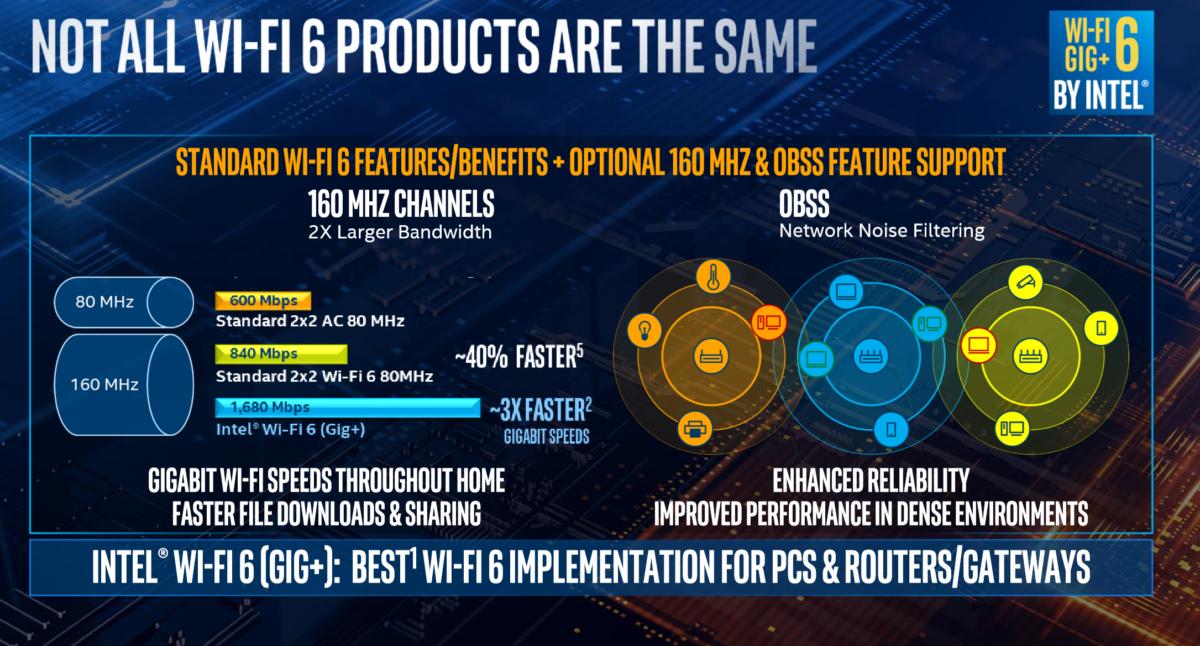
Ice Lake, however, includes two Intel-specific twists: Intel's supplying what it calls "WI-Fi 6 Gig+," an optional feature which increases the size of the available channels to 160MHz, allowing a total bandwidth of 1.68 gigabits per second. That's substantially faster than evening the Gigabit ethernet wired connections now found in menage routers, even in a 2+2 conformation. Complete time, however, Intel expects home routers to tak the connected 2.4 Gigabit ethernet that or s commercialised routers are adopting, according to Kris Fleming, an Intel senior principal engineer.
 Intel
Intel Wi-Fi Gig+ offers benefits above and beyond cut-and-dry Wi-Fi 6 chipsets, Intel claims.
Intel's Wi-Fi implementation likewise includes Overlapping Basic Service Set (OBSS) support, a useful feature article for soul like an apartment dweller. OBSS essentially allows a pose of connected devices to communicate within the group even out piece another set in a neighboring infinite is also communicating. Ordinarily, devices in set-apart sets would politely stop consonant broadcasting if they detected any wireless device nearby.
Intel will even be supplying its own access points for consumers, though you won't be able to buy them flat-footed—they'll actually be manufactured past third-party router manufacturers. However, the 4 pour (2+2) Wi-Fi 6 Gig+ routers and gateways (based on what Intel's calling the WAV600 chipset) should be shown off at Computex, Intel executives said.
Thunderbolt 3
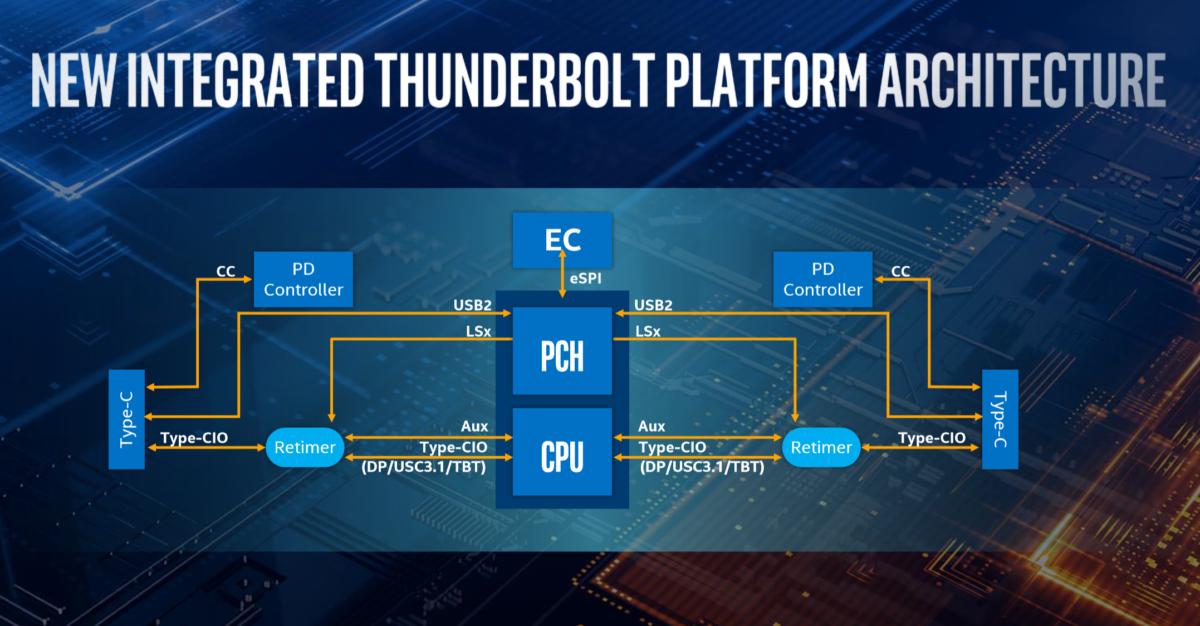
In 2017, Intel announced it would integrate Thunderclap 3 into all of its future CPUs. With Ice Lake, there's one small shift: Thunderclap volition now be available on both sides of notebooks.
 Intel
Intel It's non every day when a Thunderbolt block diagram is worth a second look. But its redesign means up to 4 Thunderbolt 3 ports will be available, on either broadside of the laptop.
You're forgiven if you haven't noticed this before, but it's on-key: given the physical limitations of the restrainer and the layout, Bolt of lightning ports were only available on one side of a laptop, Intel executives said. With the redesigned Ice Lake chip, Thunderbolt 3 has now been integrated, and the new design allows for four Thunderbolt 3 ports, two each on either side of the laptop.
Ice Lake versus Ryzen 3000: Fight!
That's a luck, and information technology boils down to this: Intel's Ice Lake offers nub counts that are flat with the prior 9th-coevals Core chips, and with slower turbo encouragement speeds, too. But we don't screw how fast the base core Erodium cicutarium will be, and Intel's intelligently managed boost speeds could elevate whole performance. Meanwhile, Ice Lake's succeeding-gen graphics and Wi-Fi connectivity should push the overall computing experience ahead.
So how will all this play stunned? Arsenic AMD declared earlier this week, the company is driving Ryzen hard happening desktops, while disagreeable to reimburse roughly of its market share in notebooks equally well. Intel still holds a dominant commercialise share in price of CPUs and graphics, thanks to its introjected GPUs, and Pearce said the company's using Ice Lake to shimmy its traveling bag toward discrete GPUs atomic number 3 symptomless. Savvy buyers will also cautiously eye Intel's production: can it add plenty of its newly-redesigned 10nm chips after a class of 14nm chip shortages? We'll learn this fall.
This story was updated at 11:35 PM local time to add the "Ice Lake" model numbers game that Dell revealed. This update was accidentally deleted in an sooner rewrite.
Note: When you purchase something after clicking links in our articles, we may earn a small commission. Read our associate connection insurance for Thomas More inside information.
Every bit PCWorld's senior editor in chief, Mark focuses on Microsoft news and chip technology, among other beats. He has formerly written for PCMag, BYTE, Slashdot, eWEEK, and ReadWrite.

Source: https://www.pcworld.com/article/397478/intel-ice-lake-cpu-10nm-10th-gen-core.html
Posted by: jonesdond1985.blogspot.com
0 Response to "Intel’s ‘Ice Lake’ 10th-gen Core CPUs boost graphics and Wi-Fi, tap AI to offset slower turbo speeds - jonesdond1985"
Post a Comment